
Right, let’s toss out the old event playbook. When you bring virtual reality into an event, you’re not just throwing a party anymore. You’re giving your guests a passport to another dimension. It’s about creating experiences so wild and memorable they’ll be swapping stories about it for years.
Welcome to the New Reality of Events
Imagine a car launch where your guests don’t just look at the new model. Instead, they climb into the driver’s seat and hoon it around a racetrack on Mars. Or what about a wedding where relatives, like Paris Hilton’s, can join the party from halfway across the world, mingling in a stunning, custom-built digital venue? This isn’t science fiction anymore; it’s what savvy event planners are doing right now.
Virtual reality has officially graduated from a geeky gadget to a serious bit of kit for crafting those “you had to be there” moments. It’s your ticket to smashing the four walls of your venue and giving guests something they never saw coming. The concept is simple: stop people from just watching, and get them doing. They become the hero of an adventure you’ve designed just for them.
Beyond the Headset Hype
So, what does this actually look like on the ground? It means weaving in layers of fun and interaction that a standard canapés-and-chitchat event just can’t compete with. This shift is blowing the doors off what’s possible for all sorts of gatherings:
- Corporate Gigs: Let clients walk around a product prototype in a virtual showroom, picking it up and examining it from every angle before it even exists.
- Weddings and Proms: Imagine letting guests step back in time, reliving the best moments of the day by immersing themselves in 360° photo and video albums.
- Brand Activations: Want social media to go nuts? Let people star in their own branded VR game or adventure. The posts will write themselves.
And this isn’t just a flash in the pan. The UK’s virtual events market, which leans heavily on this kind of immersive tech, was valued at a cool USD 5,605.54 million. It’s set to rocket to an eye-watering USD 53,741.22 million by 2035. That’s not a trend; that’s a revolution.
The real trick with VR is that it taps directly into people’s emotions. When you can whisk someone away to a place they’ve only ever dreamed of, you’re not just entertaining them—you’re creating a core memory.
At the end of the day, using VR is about making your event the one everyone else tries to copy. It shows you’re not afraid to think differently, and it delivers an experience that people simply can’t get anywhere else. This guide is your map to navigating this exciting new world of event planning. Let’s dive in.
Choosing Your VR Toolkit: From Pods to Mixed Reality
Stepping into the world of virtual reality for events can feel a bit like walking onto a film set—there’s a lot of impressive-looking kit, and it’s not always clear what each piece does. But don’t worry, you don’t need a degree in computer science to get it right. Choosing the perfect VR experience is all about matching the tech to the vibe you want to create.
Think of it like choosing a sound system. A solo acoustic set needs a different setup than a full-blown rock concert. In the same way, a high-tech corporate launch will call for a different VR approach than an intimate wedding reception. Let’s break down the main options so you can find the perfect fit for your event’s headline act.
VR Pods and Stations: The Individual Portals
VR pods and stations are your self-contained portals to another universe. Picture a sleek, enclosed booth or a designated area with a headset, controllers, and maybe a screen for onlookers to see what the player sees. When a guest steps inside, they’re whisked away on a solo adventure, completely absorbed in a world built just for them.
This setup is the workhorse of the VR event world. It’s perfect for a trade show stand where you want to dazzle potential clients with an unforgettable product demo. It’s also brilliant for parties, letting guests take turns battling dragons, exploring ancient ruins, or trying their hand at a virtual sport. Because they’re contained, they are dead simple to manage and don’t eat up a massive amount of floor space.
360° Video Experiences: Cinematic Immersion
If VR pods are private screening rooms, 360° video is like being dropped right into the middle of the film itself. This isn’t about playing a game; it’s about bearing witness to a moment. Using pre-recorded footage, guests can look around in every direction as if they were actually there.
Imagine a luxury hotel giving potential clients a breathtaking tour of their wedding venue, all from the comfort of a trade show booth. Or a charity transporting donors to the communities they’re helping, forging a powerful emotional connection that a brochure never could. It’s a storytelling tool that builds empathy and wonder, and because it doesn’t need complex controls, it’s incredibly accessible for guests of all ages.
This kind of immersion is driving huge growth. The VR market in the UK, currently valued at USD 1.8 billion, is expected to rocket to USD 6 billion by 2033, with a blistering 14.60% compound annual growth rate. That boom is fuelled by applications like VR cinemas and branded virtual gatherings.
Shared Social VR and Mixed Reality: The Metaverse Party
Now, this is where things get really interesting. Shared social VR and mixed reality (MR) tear down the walls of individual experiences, letting guests interact with each other inside a custom digital world. Think of it as your own private metaverse party, where guests’ avatars can chat, dance, and explore together—exactly how superstars like Justin Bieber now host mind-bending concerts for millions of fans at once.
Mixed reality takes it a step further by weaving the digital and physical worlds together. Guests might still see the real event space, but with digital objects and information layered right on top. This is perfect for collaborative design sessions, interactive art installations, or a shared game that unfolds across the venue floor. It’s the most social and collaborative form of virtual reality for events, turning a piece of tech into a powerful shared memory.
To make the choice a little easier, here’s a quick comparison of how these technologies stack up against common event planning considerations.
Comparing VR Experience Types for Your Event
| VR Technology | Level of Immersion | Space Requirement | Ideal For |
|---|---|---|---|
| VR Pods & Stations | High (fully immersive, individual) | Low to Medium (contained footprint) | Product demos, solo games, competitions, lead capture |
| 360° Video | Medium (passive but immersive) | Low (seated or standing in a small area) | Venue tours, brand storytelling, cinematic experiences |
| Shared & Mixed Reality | High (interactive & social) | Medium to High (requires a larger tracked area) | Collaborative sessions, social mingling, interactive installations |
Ultimately, picking the right tool for the job—whether it’s a personal escape pod, a cinematic 360° journey, or a shared digital playground—lets you direct an experience that feels perfectly tuned to your event’s unique story and audience.
What You Really Get From a VR-Powered Event
Look, let’s be honest. Beyond the “wow” factor of a futuristic headset, the real magic of using virtual reality for events is what it actually does for you. It’s not just a fancy toy; it’s a game-changing tool that fundamentally alters how people connect with your brand, your message, or your celebration. The big shift? You’re moving guests from being passive onlookers to active participants.
When you hand someone a VR headset, you’re not just showing them something cool. You’re casting them in a role. Suddenly, they’re not just attendees at a product launch; they’re test pilots getting a feel for a new jet or surgeons getting hands-on with a new medical device. Good luck getting that level of immersion from a PowerPoint slide.
Forget Likes, We’re Talking About Genuine Engagement
The holy grail for any event is getting people to actually pay attention. VR delivers this in spades. Instead of guests milling about, one eye on their phone, they are completely and utterly captivated. The experience demands their full focus, creating a bubble where your message can sink in without distraction.
Think about it. At a typical trade show, you’re lucky to get a few seconds of someone’s time as they drift past your stand. With a well-placed VR station, you can command their attention for several minutes, building a connection that’s miles deeper and far more memorable. This is how you turn a casual glance into genuine excitement.
The secret sauce of VR is its ability to create ‘core memories.’ When you engage multiple senses and put someone right in the middle of the action, the experience becomes unforgettable. Your event stops being just a date on the calendar and becomes a story they’ll be telling for ages.
The numbers don’t lie. External events have swallowed up a massive 39.15% revenue share in the virtual event space, helping to build a market projected to hit a staggering USD 18,031.0 million by 2030. That explosion is being powered by VR integrations that make everything from exhibitions to trade shows more interactive and, frankly, more fun.
Creating Branding Moments People Can’t Stop Talking About
Sticking a VR experience at your event is a statement. It screams that your brand is innovative, creative, and cares about giving people a top-tier experience. You can build entire virtual worlds from the ground up that are dripping with your branding—from the exact Pantone colour on the virtual walls to the logos on objects within the simulation.
This is pure marketing gold. The sight of people in headsets, laughing and reacting to incredible digital worlds, is a social media magnet. People can’t resist sharing something unique, and a slick VR activation will generate a tidal wave of user-generated content, pushing your event’s reach far beyond the four walls of the venue. Just look at how artists like The Weeknd have used immersive virtual concerts to reach a global fanbase—proof that a digital experience can generate just as much buzz as a physical one, if not more.
To get a real sense of this, just look at how virtual staging for real estate is flipping the property market on its head. In the same way it helps a buyer truly picture themselves in a new home, a VR experience helps an attendee connect deeply with what your brand is all about.
Your Event’s Reach? Suddenly, It’s Global.
Virtual reality completely smashes geographical barriers, opening up incredible possibilities for any gathering. Picture a wedding where elderly relatives or friends living abroad can’t make the trip. No problem. They can slip on a headset and be right there for the ceremony, wandering through a digital twin of the venue and chatting with other guests.
This isn’t just about being inclusive; it’s about amplifying your event’s impact. For a corporate launch, you could invite key international clients to an exclusive VR demo. You save them thousands in travel costs but still give them an interactive, hands-on feel for the new product. This strategic use of virtual reality for events transforms a local do into a global affair, maximising your reach and your return on investment.
Bringing Your Virtual Vision to Life with Flawless Logistics
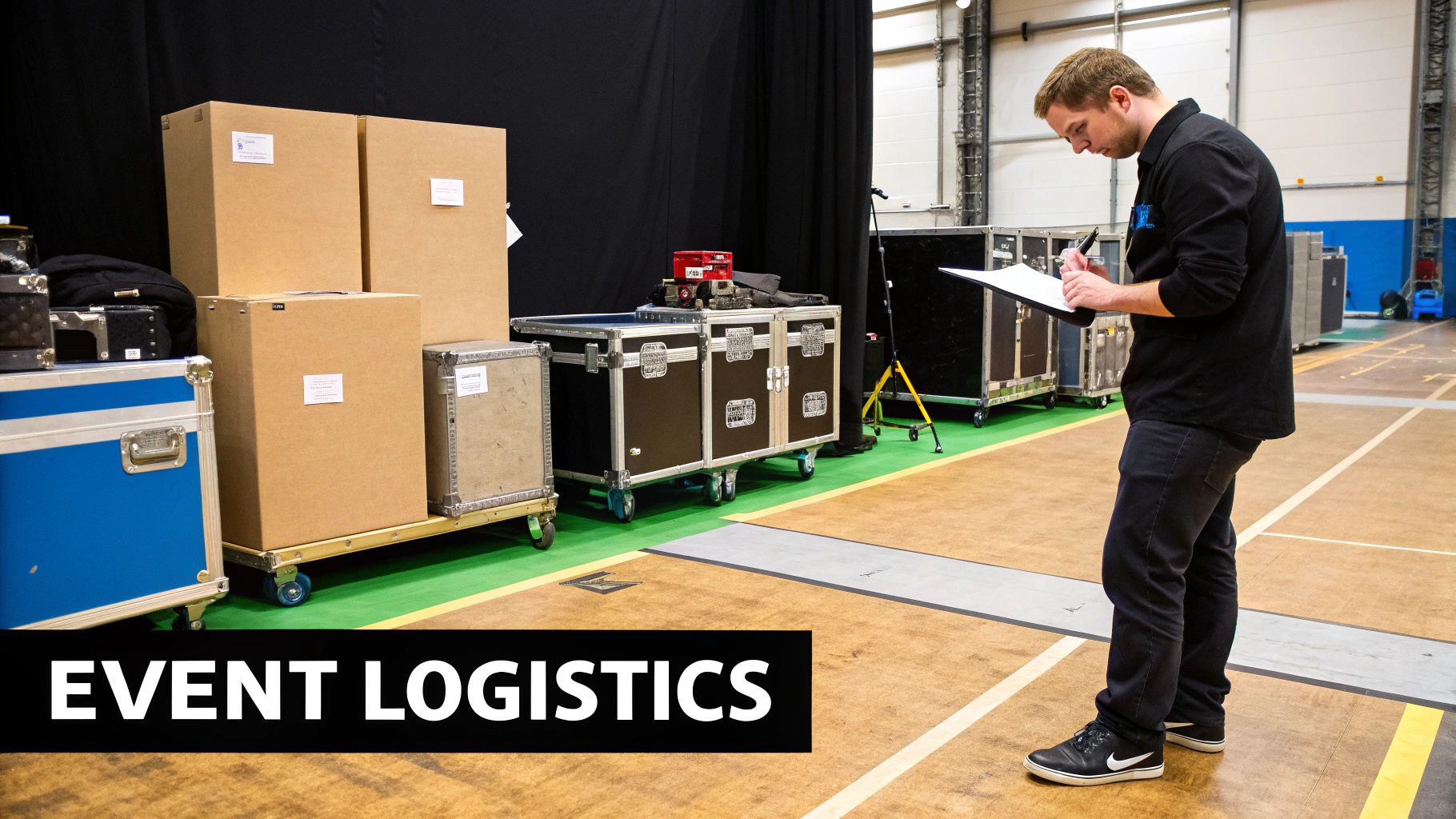
Right, you’ve picked a mind-blowing VR experience and you’re buzzing to unleash it on your guests. Fantastic. But before you can send everyone off to another dimension, you have to nail the down-to-earth, real-world stuff. Great VR at an event isn’t just about the flashy tech; it’s about making that tech completely disappear behind a seamless, frustration-free experience for your guests.
This is where flawless logistics come in. Think of it like a stage show. The audience is captivated by the magic on stage, totally oblivious to the crew behind the curtain pulling ropes and hitting cues with military precision. Getting these practical details right is what separates a breathtaking VR activation from a clunky mess of long queues and tangled wires.
Mapping Out Your Digital Playground
First things first: space. Even a simple, seated VR station needs more room than just the chair it sits on. Guests will naturally flail their arms and crane their necks, so you need a decent buffer zone to avoid any accidental whacks.
For the more ambitious ‘room-scale’ setups where people can physically wander about, you need a clearly defined, obstacle-free zone. A typical safe area is at least 3m x 3m per user. Honestly, this isn’t just a friendly suggestion; it’s a critical safety measure. You really don’t want a guest’s first encounter with your brand’s virtual world to involve a painful collision with a very real table.
Think about the entire guest journey. Where will they queue up? Where can they safely stash their drinks and bags? And where will they go afterwards, buzzing with excitement? Planning a clear flow of foot traffic prevents annoying bottlenecks and makes the whole thing feel slick and professional.
Powering the Portal and Staying Connected
VR gear is thirsty. It craves two things: power and internet. A single high-end VR station, with its powerful PC and headset, can draw a surprising amount of electricity. You can’t just daisy-chain everything into one extension lead and cross your fingers.
You’ll need dedicated power sockets for each station to avoid tripping the venue’s circuit breakers. It’s one of those small details that can bring your entire activation to a screeching halt if you get it wrong.
“Logistics are the unsung heroes of immersive events. A stable Wi-Fi connection is as vital as the headset itself. If the experience lags or drops out, the magic is instantly broken, and you’re just a person with a heavy box strapped to your face.”
Internet connectivity is the other deal-breaker. While some experiences can run offline, many rely on a stable, high-speed connection for streaming, multiplayer modes, or data capture. The venue’s standard guest Wi-Fi, often buckling under the strain of hundreds of phones, is rarely up to the job.
Essential Connectivity Checklist:
- Dedicated Connection: Always arrange for a hardwired or a private, high-bandwidth Wi-Fi network just for the VR equipment. No sharing!
- Speed Test: Get on-site and test the connection at the exact spot where the VR will be set up, well before the event kicks off.
- Have a Backup: Seriously, consider a mobile 5G hotspot as a backup. It could be the lifeline that saves your event from a technical meltdown.
The Human Element: Staffing and Support
Even the world’s most intuitive VR experience needs a human guide. Your on-site staff are so much more than technicians; they’re the friendly, welcoming faces of your virtual world. They’re the ones getting guests strapped in, explaining the controls, and making sure everyone feels comfortable and safe.
A good rule of thumb is to have at least one dedicated staff member for every one or two VR stations. This ensures someone is always on hand to help out, troubleshoot any glitches, and keep the queue moving along nicely. Imagine the chaos if a celebrity like Snoop Dogg was hosting a VR listening party and there was no one around to help guests get started—it would kill the vibe instantly.
Your team should be fully prepped to:
- Clean and sanitise headsets between every single use.
- Offer a quick, simple tutorial for any first-time users.
- Monitor guests for comfort and assist if anyone feels a bit disoriented.
- Manage the guest queue efficiently and with a smile.
Health, Safety, and Keeping it Clean
Finally, let’s talk about the serious stuff: health and safety. With virtual reality for events, you are completely responsible for the well-being of guests who are, for all intents and purposes, blindfolded to the real world. This means making the physical environment rock-solid safe is your top priority.
All cables should be taped down securely to eliminate any tripping hazards. The play area must be totally clear of furniture or any other obstructions. And hygiene is vital. VR headsets are shared items, so a strict cleaning protocol isn’t optional. Using disposable sanitary covers and wiping down equipment with antibacterial wipes between each user is standard practice for any pro supplier. This reassures guests and shows you’ve thought of everything, ensuring their adventure is memorable for all the right reasons.
Calculating Your VR Return on Investment
Alright, the event was a smash hit. You had guests gasping, laughing, and exploring new worlds. The VR was the talk of the night. But now comes the morning-after question from your boss or client: “So, was it worth it?”
Showing the value of virtual reality for events is more than just sharing fun stories. It’s about connecting the “wow” factor to the bottom line. Calculating your return on investment (ROI) is how you prove that this wasn’t just a cool gimmick, but a savvy business move.
Good news is, you’re not flying blind. Modern VR setups aren’t black boxes; they’re data goldmines. We can track almost everything, moving way beyond simple headcounts to see exactly how guests interacted with your brand or message.
The Numbers Game: Quantitative Metrics
The easiest way to make your case is with cold, hard numbers. These are the stats you can drop into a spreadsheet to show a clear return. Before you even book the VR, you need to know what you’re trying to achieve. Is it all about generating leads? Creating a social media storm? Or simply giving guests an unforgettable time?
Once your goal is set, you can focus on the right metrics:
- Lead Capture: Forget clipboards. Many VR experiences can be designed to capture a guest’s details right inside the virtual world. Imagine walking away with a list of 150 qualified leads from people who didn’t just grab a flyer, but actively stepped inside your product’s world.
- Dwell Time: This is a big one. How long did people actually stay in the experience? An average dwell time of 7 minutes per person is huge. It shows deep, meaningful engagement that a static banner or a 30-second video could only dream of.
- Social Media Reach: A slick VR station is pure Instagram bait. People love sharing photos and videos of themselves (and their friends) wearing headsets and looking amazed. By tracking your event hashtag and mentions, you can see how much user-generated content exploded online, extending your reach far beyond the four walls of the venue. It’s the kind of authentic buzz money can’t always buy.
Beyond the Spreadsheet: Qualitative Feedback
Of course, not everything that counts can be counted. The true magic of VR often lies in how it makes people feel. This qualitative feedback is what gives your numbers colour and context, and it speaks volumes about the long-term impact on your brand.
Don’t skip this step. Send out a post-event survey with specific questions. “How did the VR experience change your view of our brand?” or “On a scale of 1-10, how memorable was the virtual reality part of the event?” These testimonials are powerful social proof you can use to justify future budgets.
The real ROI of VR is often in its power to change minds and build emotional connections. Big names like Audi and IKEA use it to see how virtual test drives or kitchen planners affect a customer’s desire to buy. They’re building brand loyalty that sticks around long after the headset comes off.
While digging into the VR-specific numbers, it’s also smart to look at strategies for measuring overall event ROI to see how it all fits into the bigger picture.
A Simple ROI Calculation
Ready for some back-of-the-napkin maths? A basic ROI formula can paint a very clear picture.
(Net Profit from VR / Cost of VR) x 100 = ROI %
Let’s run a quick example. Say the VR setup cost you £5,000 all in. From the leads you captured directly within the experience, you closed £20,000 in new business.
Here’s how it shakes out: ((£20,000 – £5,000) / £5,000) x 100 = a whopping 300% ROI.
Now that’s a number that makes people sit up and take notice. When you combine powerful stats like that with glowing feedback from your guests, you’ve built an undeniable case. You didn’t just invest in virtual reality for events; you invested in real, measurable success.
Budgeting for VR and Vetting the Right Supplier
Right, let’s get down to brass tacks. You’ve dreamed up an incredible virtual reality for events experience, but now it’s time to make the numbers add up. Budgeting for VR isn’t some mysterious dark art; it’s simply about knowing what you’re paying for and finding a supplier who can deliver the goods without any last-minute surprises.
Costs can swing dramatically. A few headsets for a party will be a world away from a fully bespoke virtual world for a product launch. Think of it like booking a headline act for a festival – you wouldn’t hire the first band that came along. You’d check their track record and make sure they could handle the main stage. The same logic applies here. You need a partner who gets your vision and has the technical know-how and on-the-ground experience to pull it off perfectly.

Cracking the Code of VR Pricing
VR pricing is rarely a one-size-fits-all deal. Most suppliers offer packages, which is a great way to see exactly what you’re getting for your money. A simple setup for a private party will naturally cost a fraction of a multi-day installation for a huge corporate conference.
To give you a clearer picture, let’s break down some typical tiers.
The key to smart budgeting is clarity. Don’t just ask for a price; ask for a detailed breakdown. Understanding the cost of hardware, software, staffing, and any customisation is crucial to avoiding scope creep and hidden fees.
Example VR Event Packages and Budget Guide
To help you get started, here’s a look at what you might expect to find when you start getting quotes. These are ballpark figures, of course, but they offer a solid baseline for your planning.
| Package Tier | Typical Inclusions | Estimated Price Range (per day) |
|---|---|---|
| Starter | 2-3 VR headsets (e.g., Quest 3) with a library of games, one on-site technician, and delivery/setup. | £500 – £1,200 |
| Pro | 4-6 high-end VR stations (PC-powered), branded in-game content, two technicians, and a viewing screen for spectators. | £1,500 – £3,500 |
| Bespoke | Fully custom-built virtual world or branded game, multiple technicians, project manager, and premium hardware. | £5,000+ |
Remember, these are just guides. Always have a proper chat with potential suppliers to get a detailed quote tailored to your specific event.
Your Supplier Vetting Checklist
Finding the right supplier is probably the most important thing you’ll do. A great partner does more than just drop off equipment; they become an extension of your own event team. Before you sign anything, make sure you grill them with these essential questions.
- What’s Your Technical Support Plan? Ask them straight up: what happens if something goes wrong? Do they bring backup gear? Will the technician who turns up on the day know what they’re doing? You need confidence in their Plan B.
- Can I See Your Health and Safety Protocol? This is a complete non-negotiable. Any professional outfit should be able to instantly show you their documentation on equipment hygiene, trip hazard prevention, and guest safety procedures.
- Show Me Your Portfolio. Don’t just take their word for it. Ask for case studies or photos from events they’ve handled that are similar in scale and style to yours. Seeing is believing.
- How Do You Handle Branding and Customisation? Find out just how deep the customisation goes. Can they pop your logo into the virtual world? Can they create custom-branded experiences? The more they can make it yours, the better the impact.
- What Are Your Staff Like? The people they send are the face of the experience. Are they well-trained, professional, and genuinely excited to help your guests dive in? A bored-looking technician can kill the vibe instantly.
Choosing your VR supplier isn’t just a transaction; it’s a partnership. A bit of extra digging at the start will ensure your investment pays off with a flawless, unforgettable experience for every single guest.
Got Questions About VR at Your Event? We’ve Got Answers.
Jumping into virtual reality for an event can feel a bit like directing your first movie – exciting, but a little daunting. Let’s be honest, you’ve probably got a few nagging questions. Not to worry. We’ve heard them all before, and we’re here to put your mind at ease.
“Won’t My Guests Feel a Bit Queasy?”
This is always the first question, and it’s a fair one! We all have a mate who tried some dodgy VR headset five years ago and spent the rest of the day feeling green. But thankfully, technology has moved on. A lot.
Think of it this way: there’s a world of difference between a rickety old roller coaster and a brand-new, butter-smooth thrill ride. Professional-grade VR headsets used for events have incredibly high refresh rates and precision tracking. This means the virtual world moves perfectly in sync with your head, which is the key to tricking your brain and avoiding that dreaded motion sickness.
The pros who run these setups are also brilliant at guiding first-timers. They’ll start guests off with gentle, comfortable experiences to help them find their ‘VR legs’ before diving into anything more adventurous.
Don’t let outdated fears hold you back. A professionally run VR station is all about comfort and fun. Seated experiences are a fantastic starting point and ensure everyone from your curious grandad to your tech-obsessed nephew can join in without a wobble.
“How Much Room Do I Actually Need to Set Aside?”
This really depends on the kind of journey you want to send your guests on. There’s no single answer, but it’s simpler than you think.
If you’re planning on offering a stunning 360° video tour of, say, the Amazon rainforest, a simple seated setup is all you need. A tidy 1.5m x 1.5m spot per chair is perfect. It’s neat, compact, and easy to slot into almost any floor plan.
But if you’re going for the full ‘wow’ factor with a room-scale experience where guests can physically walk around and interact with their virtual world, you’ll need a bit more space. The gold standard is a clear safety zone of 3m x 3m per player. This gives them the freedom to explore without bumping into tables, pillars, or each other! Your supplier will be a master at looking at your venue plan and carving out the perfect spot.
“Is VR Really for Everyone? What About My Older Guests?”
One hundred percent, yes! The trick is in the curation. Virtual reality is so much more than just high-octane video games. The sheer variety of experiences available today is mind-boggling, and there’s truly something for every taste and temperament.
For an event with a wonderfully diverse guest list, you can offer a hand-picked menu of virtual adventures:
- For the Creatives: Imagine painting with light in three dimensions. Apps like this are gentle, mesmerising, and a massive hit with all ages.
- For the Explorers: Offer tours of the Great Pyramid or a journey through our solar system. These are all about awe and wonder, with zero pressure.
- For the Playful: Simple, fun rhythm or puzzle games bring out a little friendly competition and are super intuitive to pick up.
A great VR partner will work with you to build a playlist that speaks to your specific crowd, making sure the technology feels like an amazing, inclusive treat, not an intimidating challenge.